Why the right idea often shows up early
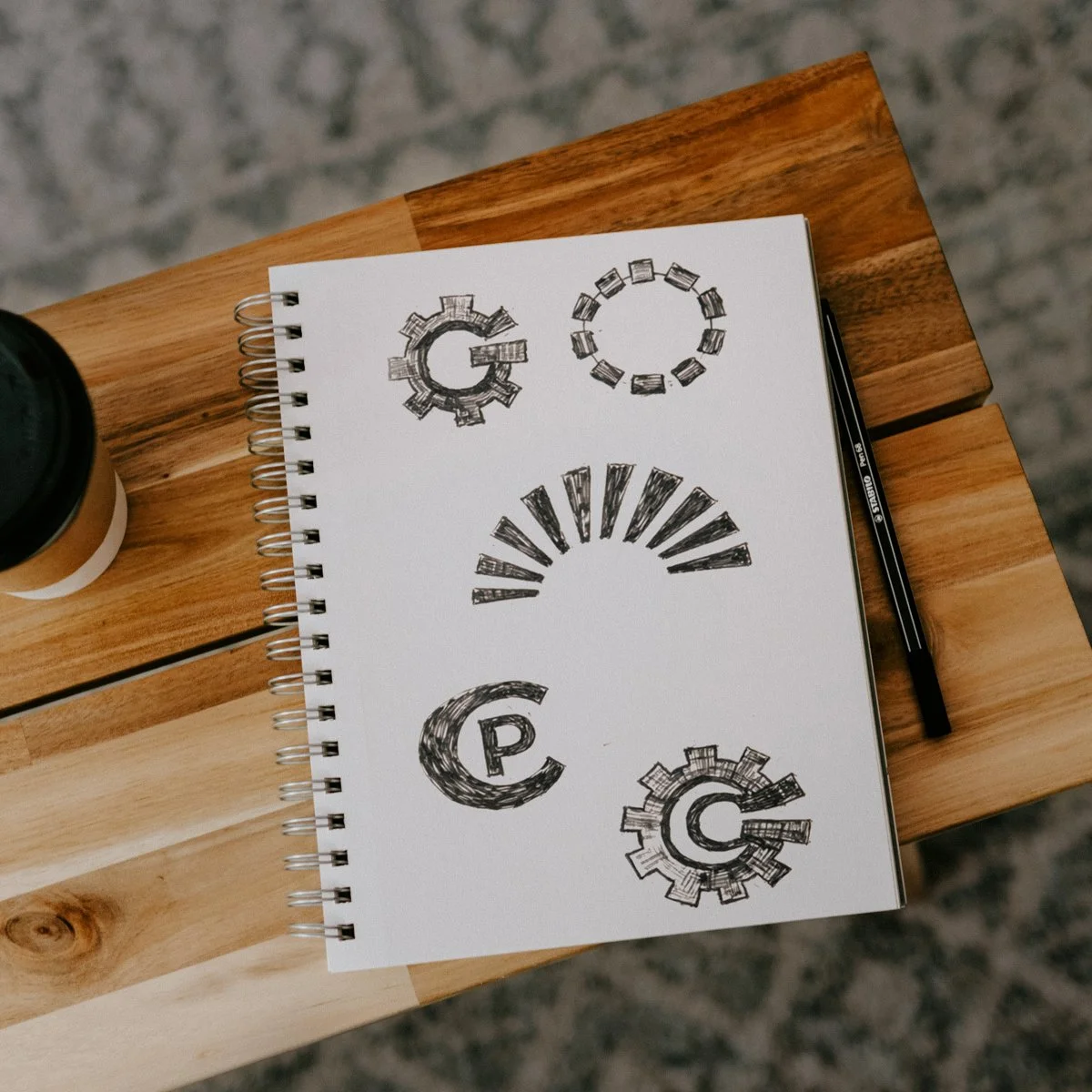
At the start of the year I was working on a new identity for PlantCore Engineering, and this was the first page of sketches.
It’s funny showing this stage because it’s not the part people usually associate with design work. When most people think about a logo project, they picture polished visuals, neat mockups, and a set of refined concepts presented like a menu. The assumption is that the designer explores everything and eventually lands on something that works.
Sometimes projects do run like that. But more often than not, the direction that ends up succeeding appears far earlier than anyone expects.
On this project one of the ideas was there almost immediately. It wasn’t finished, it wasn’t neat, and it definitely wasn’t presentation ready, but the thinking behind it was solid. The shapes made sense for the sector, the form was simple enough to be recognisable, and it had room to develop into a system rather than just a standalone mark.
From that point the job changed.
It stopped being about generating more options and became about understanding whether that idea deserved to exist. That meant stepping back, looking at how it might behave in the real world, and stress-testing it properly. Would it still read at a small size? Would it embroider cleanly? Would it hold up on a vehicle, a document header, or a site sign? Would it still feel appropriate a few years down the line?
A lot of the work in branding isn’t actually invention. It’s evaluation.
There’s a temptation in creative projects to keep producing. More concepts, more variations, more visual activity. It feels productive and it reassures everyone involved that exploration is happening. But quantity and clarity are different things. Endless options can just as easily dilute a project as strengthen it.
The value often sits in recognising when you’ve found the direction and having the confidence to develop it properly rather than abandoning it too early. Experience helps with that. Not because it gives you a magic answer, but because you begin to recognise patterns. You see which ideas are structural and which are decorative. You see which marks can carry a brand and which only work in isolation.
That’s also the stage where restraint matters. It’s easy to keep adding ideas just to prove you’ve explored everything. Harder to stop, commit, and refine. Avoiding the urge to throw sh*t at the wall is often what keeps a project coherent.
The sketches themselves are a small part of the process but an important one. Sketching isn’t the part that comes naturally to me. I would happily jump straight onto the computer every time. Software feels efficient, precise, and controlled.
But the problem with going straight to a screen is that it encourages polishing too early. You start adjusting kerning, alignment, and colour before you’ve even confirmed the idea is right. Paper removes that temptation. It’s quicker, looser, and honest. If an idea doesn’t work in pen, it won’t be saved by Illustrator.
Getting ideas onto paper is simply the fastest way to get them out of my head and actually see what’s there. It’s messy, a bit uncomfortable, and never looks impressive, but it clarifies thinking. It also prevents over-attachment to execution. A rough sketch is easier to change than a perfectly drawn vector.
By the time the work reaches the computer, the aim isn’t to discover the idea anymore. It’s to refine, balance, and build consistency around something that already makes sense.
The finished PlantCore mark went through development, not reinvention. The proportions were tuned, spacing adjusted, and applications tested. What changed wasn’t the concept, just the understanding of it.
Good branding rarely comes from a sudden moment of inspiration and it rarely comes from endless production either. It usually comes from recognising a strong idea early and giving it the time and attention it needs to hold up in the real world.
Most of the real design work happens long before anything looks finished.
Where this matters
This is also why I tend to work best as a partner alongside internal teams rather than just delivering a file at the end. The value isn’t only in the final artwork, it’s in helping clarify direction early and preventing projects from drifting before they properly start.
If you’re planning a rebrand, launching something new, or you simply know your current brand isn’t quite pulling its weight anymore, the useful conversations usually happen before any visuals appear. Brand identity projects, campaign work, and ongoing design support all benefit from getting that thinking right at the beginning rather than fixing it later.
You can see more examples of how that thinking translates into real projects in my recent work and case studies, or read a bit more about how I approach projects on my design services page.
And if you’re at the stage where you’re trying to work out what something should be, rather than just what it should look like, feel free to get in touch. Even a short conversation early on can save a lot of time later.